


If you want to succeed on Amazon, you need a system. It’s that simple. Forget the get-rich-quick schemes and magic bullets; what really works is nailing the fundamentals, time and time again.
This means having a repeatable process for everything—from picking a winning product and validating its profit potential to mastering the beast that is Amazon's fulfillment network. When you have a solid system, the chaos of the marketplace starts to look a lot more like a manageable, scalable business.
Your Blueprint for a Profitable Amazon Business
Let's cut right to it. Making money on Amazon is built on one core philosophy: secure your first profit, then scale like hell. It’s easy for new sellers to get buried under a mountain of tasks, but the truth is that a tiny fraction of your activities will drive 80% of your results. This guide is your blueprint for focusing on only those things.
We're going to walk through how to navigate the shark-infested waters of Amazon by concentrating on the pillars that separate the seven-figure sellers from the ones who burn out in six months. Instead of chasing shiny objects and fleeting trends, you'll learn how to build a real, resilient brand from the ground up.
Mastering the Core Pillars of Amazon Success
A sustainable business needs a clear, actionable game plan. We’ve structured this entire playbook around the handful of skills every single successful seller has mastered. Think of them as gears in an engine—when they all work together, they create a powerful momentum that drives your brand forward.
Here’s a sneak peek at what we're about to tear down:
- Finding Winning Products: We’ll get into the nitty-gritty of data-driven methods for sniffing out high-demand products hiding in low-competition corners of the marketplace. This ensures your very first product isn't a gamble, but a calculated move with a clear path to profitability.
- Crafting Listings That Actually Convert: I'll teach you the art and science behind Amazon SEO. You’ll learn how to create product pages that don't just rank at the top of search results, but actually convince real people to pull out their wallets and click "Add to Cart."
- Mastering Amazon Advertising: We'll demystify Amazon PPC and show you how to use it as a strategic weapon. You'll learn how to drive hyper-targeted traffic, gather priceless customer data, and light a fire under your sales—all without torching your budget.
- Leveraging Powerful Fulfillment: We'll break down Fulfillment by Amazon (FBA) so you can see how leveraging Amazon’s massive logistics machine can instantly boost customer trust and, more importantly, free you up to focus on what really matters: growth.
The goal here isn't just to launch one product. It's to build a system. A truly successful Amazon business is an asset that spits out predictable revenue because you've mastered the inputs: the product, the marketing, and the logistics.
Of course, launching is just the start. You have to keep learning how to increase retail sales, which involves constantly improving your sourcing, merchandising, and marketing—all skills that apply directly to the Amazon platform. We'll even get into how to weave modern tools like AI and social commerce into your strategy, giving you the complete playbook for building a brand that lasts.
Finding and Validating Your First Winning Product
Every successful Amazon business starts with one thing: the right product. This isn't a lottery. Your journey to selling successfully on Amazon kicks off long before you ever build a listing or spend a dime on ads. It all boils down to a repeatable, data-driven process for finding an opportunity that everyone else has overlooked.
Let's be real: the sheer size of the Amazon marketplace is both a blessing and a curse. You have access to millions of customers, but you're also up against a staggering amount of competition. The secret isn't to go head-to-head with the big players in crowded categories. It's to hunt for specific, underserved niches where you can plant your flag and build a real business without needing a massive war chest.
This strategy is more critical now than ever. The playground is dominated by independent sellers just like you. In fact, third-party sellers now account for a massive 61% of all units sold on the platform, a huge leap from just 45% back in 2015. This proves that smart strategy—not a household brand name—is what truly wins the game.
Uncovering Product Ideas with Data
Stop guessing what might sell and start letting the data do the talking. This is where product research tools become your best friend, transforming the chaos of the marketplace into clear, actionable insights. A platform like Helium 10 is indispensable, allowing you to slice and dice Amazon’s entire catalog using criteria that scream "opportunity."
Here’s a practical workflow to start digging for gold:
- Set Your Search Criteria in Helium 10's Black Box: Start by defining what an ideal product looks like. For example: set monthly revenue between $5,000 and $15,000, review count to a maximum of 150, and price between $25 and $75. This focuses your search on products with proven demand but low competition.
- Drill Down into Niche Categories: Instead of a broad search, select specific sub-categories. For example, instead of "Home & Kitchen," choose "Home & Kitchen > Kitchen & Dining > Kitchen Utensils & Gadgets." This helps you find less obvious opportunities.
- Analyze the Results for Consistency: Once you have a list of potential products, look for a consistent Best Sellers Rank (BSR). A product with a steady BSR of 15,000 is often better than one that spikes to 1,000 in December but sits at 50,000 the rest of the year. You want stable, year-round demand.
Let’s say this workflow leads you to a "silicone travel bottle set." The revenue numbers are solid ($8,000/month), and the top sellers all have fewer than 120 reviews. That’s a massive green light. It indicates the niche isn't saturated, leaving a perfect opening for a new seller to enter and improve upon the existing offers.
This whole process is about a simple, powerful path: achieve profit, then scale.
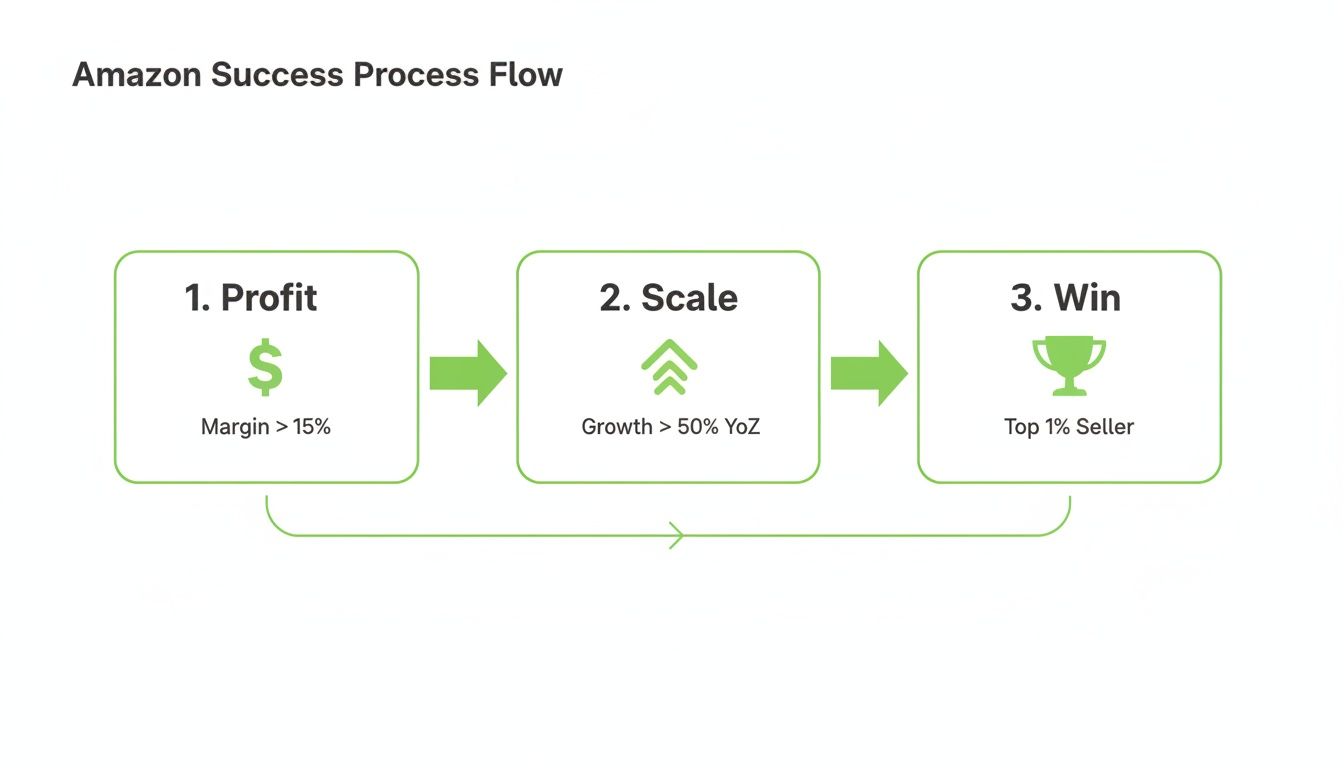
This flowchart nails it. Profitability is the foundation. Once you have that, you can pour fuel on the fire, scale up your operations, and start to really own your corner of the market.
Validating Your Idea and Spotting Weaknesses
Finding a promising idea is just step one. Now comes the critical part: validation. You need to confirm that there's real demand and, more importantly, a clear way for you to do things better than the current sellers. Time to put on your detective hat.
The best product ideas often come from solving a problem. Your job isn't to invent something brand new, but to find an existing product and make it 10% better by listening to what customers are already complaining about.
Here's a step-by-step validation workflow:
- Analyze Competitor Reviews: Go to the listings of the top 3-5 competitors for "silicone travel bottle set." Filter their reviews to show only 2-star and 3-star ratings.
- Identify a Common Complaint: Read through the reviews and look for a recurring theme. You might notice multiple people complaining, "The lids leak in my toiletry bag," or "The opening is too small to pour lotion into." This is your opportunity.
- Formulate Your Improvement: Your product improvement is now clear: work with a supplier to create a bottle with a double-seal, leakproof cap and a wider mouth. This becomes your unique selling proposition.
- Confirm Search Demand: Use a keyword tool to check the search volume for your main keywords. If "silicone travel bottles" has 5,000 monthly searches and "leak proof travel bottles" has 2,000, you have confirmed, active demand.
Calculating True Profitability
Finally, you have to run the numbers. A product can look like a home run on the surface, but Amazon fees can quickly turn it into a dud. You have to account for every single cost to know if you actually have a business.
An FBA Profitability Calculator is non-negotiable here. It gives you a crystal-clear view of your potential earnings. Here’s a quick breakdown of what that looks like for a product selling at $25:
| Cost Component | Example Calculation (for a $25 product) |
|---|---|
| Landed Product Cost | $5.00 (manufacturing + shipping to US) |
| Amazon Referral Fee | $3.75 (typically 15% of the sale price) |
| FBA Fulfillment Fee | $4.50 (based on size and weight) |
| Estimated Ad Spend | $2.50 (assuming a 10% ACoS) |
| Total Costs | $15.75 |
| Net Profit Per Unit | $9.25 |
| Profit Margin | 37% |
You should be aiming for a healthy net profit margin of 25-40%. Anything less, and you won't have enough cash flow to reinvest in more inventory and marketing. If the numbers don't add up, walk away. This entire process is designed to save you from betting on a losing horse.
Once you’ve found a product that passes these tests, you’re ready for the next phase. To make sure you hit the ground running, check out this in-depth guide on how to launch a product on Amazon for a powerful start.
Crafting Product Listings That Convert and Rank
Let's be blunt: a brilliant product is completely invisible if customers can't find it. The difference between a bestseller and a total flop often boils down to a single thing: a product listing that's been expertly engineered to both rank on Amazon and convince real people to click "Add to Cart."
This isn't about mindlessly stuffing keywords into a text box. It's about telling a compelling story that solves a customer's problem.
Think of your listing as your 24/7 digital salesperson. Its job is to grab attention, build trust, answer questions before they're even asked, and ultimately, close the sale. A poorly crafted listing is like a silent salesperson standing in the corner—it just gets ignored. A great one, however, actively engages shoppers and guides them straight to checkout.
The Anatomy of a High-Converting Listing
Every single element of your product detail page has a specific job to do. To really succeed on Amazon, you need to optimize each component, not just one or two. They all have to work together to create a powerful, cohesive message that drives both traffic and conversions.
Let’s break down the core components you need to nail:
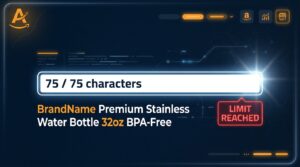
- Product Title: This is your most powerful SEO real estate. A practical example for our travel bottle might be: "Leak-Proof Silicone Travel Bottles (4-Pack, 3oz) – TSA Approved Squeeze Tubes for Toiletries, Shampoo, & Conditioner – Wide Mouth Design". This includes the main keyword, key features (4-pack, 3oz), a major benefit (TSA Approved), and the solution to a pain point (Wide Mouth).
- Bullet Points (Key Product Features): This is where you sell the benefits. Use this space to answer the customer's core question: "What's in it for me?" Each bullet should target a specific pain point or desire they have.
- Product Description & A+ Content: For brands enrolled in Brand Registry, A+ Content replaces the plain old text description. This is your chance to use rich media—high-quality images, comparison charts, and brand stories—to make your product come alive and leave the competition in the dust.
- Backend Search Terms: These are the hidden keywords that customers don't see, but Amazon's A9 algorithm certainly does. For our example, you might add: "refillable travel containers," "carry on liquid bottles," "silicon travel size," and common Spanish terms like "botellas de viaje."
One of the biggest mistakes sellers make is treating their listing as a static document. Your listing is a living asset. You should be constantly testing and tweaking your title, images, and copy based on performance data and customer feedback to keep improving its effectiveness.
Writing Copy That Sells
The secret to persuasive copy is shifting your mindset from features to benefits. A feature is what your product is or has. A benefit is what your product does for the customer. People don't buy a drill; they buy the hole it creates.
Here’s a practical example for a reusable silicone food bag.
Before (Feature-Focused):
- "Made of 100% food-grade silicone"
- "Leakproof pinch-lock seal"
- "Holds up to 50 oz"
After (Benefit-Driven):
- Keep Your Food Fresh Longer: Our airtight pinch-lock seal locks in flavor and freshness, so you can stop throwing away half-eaten avocados and wilted herbs.
- Enjoy Mess-Free Lunches: Confidently pack soups, sauces, and smoothies without worrying about disastrous leaks in your work bag or your kid's backpack.
- Save Money & Reduce Waste: Ditch single-use plastic bags for good with a durable, dishwasher-safe solution that’s kinder to your wallet and the planet.
See the difference? The second version connects directly with the customer's actual problems and desires—saving money, avoiding messes, and being eco-conscious. That's what drives a purchase.
Mastering Visual Storytelling
On Amazon, your images do most of the heavy lifting. Shoppers can't touch or feel your product, so your photos and graphics have to bridge that physical gap. A truly effective visual strategy includes a mix of different image types to tell the whole story.
A complete image stack should always include:
- The Hero Image: This is your main event—a crystal-clear shot of your product on a pure white background. This is non-negotiable and must follow Amazon's strict rules. You can get into the nitty-gritty of the technical specs in this detailed breakdown of Amazon images requirements.
- Infographics: For the travel bottles, an infographic could show an icon of an airplane with "TSA Approved" text, a graphic illustrating the wide mouth for easy filling, and the dimensions (3oz / 90ml).
- Lifestyle Photos: Show the product in use. For example, a photo of someone easily squeezing shampoo from the bottle at the gym or packing them into a carry-on suitcase. This helps the customer visualize themselves actually benefiting from your product.
- Comparison Charts: Create an image that compares your bottle set (4-pack, leak-proof cap, wide mouth) to a generic competitor (2-pack, standard cap, narrow mouth) to visually highlight your superior value.
When you combine benefit-driven copy with compelling visual storytelling, you create a listing that doesn't just get discovered by Amazon's algorithm—it also convinces real humans that your product is the exact solution they've been searching for.
You've got a winning product and a killer listing, but how do you actually get your items into customers' hands? This is where your fulfillment strategy becomes a massive lever for success. For many sellers, the secret to scaling efficiently is tapping into Amazon’s own logistics powerhouse: Fulfillment by Amazon (FBA).
When you use FBA, you’re basically handing over the entire backend of your business to Amazon. You send your products in bulk to their massive fulfillment centers, and they take it from there—storing your inventory, picking and packing orders, and handling all the shipping, customer service, and even returns. It’s the ultimate way to free yourself from the daily grind of taping up boxes and making post office runs.
Even more importantly, enrolling in FBA instantly makes your products Prime-eligible. That little blue Prime badge is one of the most powerful conversion tools on the platform. It gives customers the confidence to click "buy," knowing they’ll have their order in a day or two.
Your First FBA Shipment Workflow
Prepping your first FBA shipment can feel a bit intimidating, but it’s a pretty straightforward process if you follow the right steps. This isn't the place to cut corners, though—mistakes here can be costly, leading to delays or even having your inventory rejected at the warehouse. Precision is everything.
Here’s a practical workflow to get it right the first time:
- Create a Shipping Plan in Seller Central: Navigate to "Manage Inventory," select the checkbox next to your product, and choose "Send/Replenish Inventory." This initiates the step-by-step workflow.
- Confirm Packaging Details: Amazon will ask if the items need prep (like poly-bagging). If your product is a set of 4 bottles sold together, you must package them as one unit and apply a "Sold as a Set" label.
- Print FNSKU Labels: In the workflow, Amazon will generate a PDF of FNSKU barcodes. Print these on label paper and apply one to each saleable unit, covering any existing manufacturer barcodes.
- Pack Your Shipping Boxes: Place your labeled units into shipping cartons. Weigh and measure each box, then enter the dimensions and weight into the shipping plan. Never exceed 50 lbs per box.
- Print Shipping Labels & Ship: Amazon will generate the final shipping labels (e.g., for UPS). Affix one to each box and schedule a pickup or drop them off at the designated carrier. If you’re based in Australia, finding a reliable carrier is key. This best courier service Australia comparison guide for ecommerce success is a great resource for figuring that out.
This logistics advantage is a huge reason FBA sellers often pull ahead of the competition. In fact, data shows that 58% of Amazon sellers turn a profit within their first year, with FBA users leading the pack. It's no surprise that over 82% of all sellers use FBA; the trust and visibility from the Prime badge are just too hard to replicate on your own.
Fulfillment Model Comparison FBA vs FBM vs 3PL Hybrid
Deciding on a fulfillment strategy can be tough. The table below breaks down the most common models—FBA, FBM, and a 3PL hybrid approach—to help you see which one aligns best with your business goals.
| Feature | Fulfillment by Amazon (FBA) | Fulfillment by Merchant (FBM) | 3PL Hybrid Model |
|---|---|---|---|
| Prime Eligibility | Automatic, a major conversion driver | Possible via Seller Fulfilled Prime (strict criteria) | Can support SFP, depends on 3PL network |
| Control Over Inventory | Low; inventory is in Amazon's hands | High; you manage your own stock | Moderate to high; you work directly with your 3PL partner |
| Fees | Fulfillment, storage, and various other fees | Shipping costs, packing materials, labor | Storage, fulfillment, and account management fees |
| Multi-Channel Sales | Possible with Multi-Channel Fulfillment (MCF) but can be costly | Easy; you control shipping to all channels | Ideal; designed for seamless multi-channel fulfillment |
| Customer Service | Handled by Amazon | Your responsibility | Can be handled by 3PL or you, depending on the agreement |
| Best For | Fast-moving, standard-sized items; sellers wanting to scale | Niche, oversized, or slow-moving items; sellers new to ecommerce | Businesses with multi-channel sales or diverse product catalogs |
Ultimately, the right choice depends on your product line, sales volume, and long-term vision. Many successful sellers end up using a combination of these models as they grow.
Beyond FBA: The Hybrid Model
While FBA is a game-changer, it’s not a one-size-fits-all solution. For items that are oversized, heavy, or just don’t sell very quickly, FBA storage fees can chew through your profits in a hurry. This is where a hybrid approach using a Third-Party Logistics (3PL) provider becomes a really smart move.
Think of a 3PL as your own personal warehouse team. They can store your inventory, prep it for FBA shipments, and even fulfill orders that come from other channels like your Shopify store or TikTok Shop.
Here's a practical example of a hybrid model: You sell large, heavy weighted blankets and small, lightweight pillowcases. You would keep the fast-selling pillowcases in FBA to get the Prime badge. You'd store the bulky weighted blankets at a 3PL, where storage fees are much lower. When you get an Amazon order for a blanket, you fulfill it yourself (FBM) or have the 3PL ship it. This strategy optimizes for both speed and cost.
Choosing the right partners is crucial here. If you're sourcing from overseas, a solid freight forwarder is an essential part of your logistics chain, helping you navigate the headaches of international shipping. Our guide on choosing a freight forwarder for Amazon FBA can walk you through finding the right fit. A strategic approach ensures your supply chain stays robust, cost-effective, and ready to scale right alongside your business.
Driving Targeted Traffic with Amazon PPC
You’ve done the hard work. Your product is live, and your listing is a finely-tuned machine. Now what? Waiting around for organic traffic to trickle in is a recipe for a slow, painful death in the Amazon jungle. If you want to build a real business, you need to be proactive, and that means getting your hands dirty with Amazon Pay-Per-Click (PPC).
Stop thinking of PPC as just another expense. It's not. It's your single best data-gathering tool. PPC gives you a direct line into your customers' brains, showing you the exact words they type into the search bar right before they buy something. That kind of intel is pure gold, and it will shape everything from your listing copy to your next product idea.
Understanding the Different Ad Types
Amazon’s ad platform has a few different tools in the toolbox. Using the right one for the job is the difference between a healthy Return on Ad Spend (ROAS) and just lighting your money on fire.
Let’s get to know the main players you’ll be working with:
- Sponsored Products: These are the bread-and-butter ads you see everywhere—sprinkled into search results and popping up on competitor product pages. They’re the workhorse of your PPC strategy, built to drive clicks and direct sales.
- Sponsored Brands: See that banner ad at the very top of the search results? The one with a logo, a catchy headline, and a few products? That’s a Sponsored Brands ad. They’re fantastic for building brand awareness and funneling shoppers to your Amazon Storefront.
- Sponsored Display: This is your secret weapon for retargeting. These ads follow shoppers who viewed your product but didn't pull the trigger. They can show up both on and off Amazon, giving potential customers a gentle nudge to come back and finish their purchase.
When you’re just launching a new product, hitting it with a combination of Sponsored Products and Sponsored Brands is a killer one-two punch. One drives the immediate sales you need, while the other starts carving out your brand’s territory from day one.
A Practical PPC Launch Strategy
Diving into PPC without a game plan is a rookie mistake. A structured approach is absolutely critical to make sure you're gathering good data from the get-go and moving from broad discovery to sharp, profitable targeting.
Here’s a simple, proven workflow to get your campaigns off the ground:
- Launch an Automatic Campaign: In your campaign manager, create a "Sponsored Products" campaign. Choose "Automatic targeting." Set a daily budget of $20-$30 and a default bid of around $0.75. Let this run for 10-14 days without making changes.
- Harvest Keywords from the Search Term Report: After two weeks, navigate to your auto campaign and open the "Search Term Report." Sort the data by "Orders" to see which customer search terms generated sales.
- Create a Manual "Exact Match" Campaign: Take the top 5-10 converting search terms from your report. Create a new "Sponsored Products" campaign with "Manual targeting." Create one ad group and add these keywords as "Exact Match." This tells Amazon to only show your ad when a customer types that exact phrase.
- Create a Manual "Broad Match" Campaign: Take the same keywords and create another manual campaign, but this time add them as "Broad Match." This will help you discover new, related keywords over time.
- Add Negative Keywords: Go back to your auto campaign's search term report. Find terms that got clicks but zero sales (e.g., "plastic travel bottles"). Add these as "Negative Exact" keywords to your auto campaign to stop wasting money on irrelevant clicks.
The whole point of that initial auto campaign isn’t to be wildly profitable right away. Think of it as a research tool. You're paying Amazon to tell you exactly which keywords your best customers are using. This data is the rock-solid foundation for every profitable manual campaign you'll build later.
Optimizing for Profitability
Once your manual campaigns are up and running, the real work begins. Optimization is a never-ending cycle of refining your targeting and tweaking your bids to squeeze every last drop of profit out of your ad spend.
Your most important ongoing task is managing negative keywords. Head back to your Search Term Report and hunt for terms that are getting clicks but zero sales, or are just plain irrelevant.
- Here’s a real-world example: Let's say you sell a premium glass water bottle. Your report shows you're paying for clicks from the search term "cheap plastic water bottle." That's just wasted money. You need to add "plastic" and "cheap" as negative phrase match keywords in all relevant campaigns. This tells Amazon to never show your ad if a search contains those words.
By constantly trimming the fat and adding negative keywords, you force your budget to work smarter, not harder. This simple habit is what separates the pros from the amateurs and is a critical part of learning how to sell on Amazon successfully. It’s how you turn PPC from a cost center into a reliable profit-generating machine.
Scaling Your Brand On and Off Amazon
Think of your Amazon store as your home base, not the final destination. If you're playing the long game, true success comes from building a brand that customers recognize and seek out, whether they're on Amazon or scrolling through their social feeds. This means going beyond just tweaking listings and PPC bids to create a genuine brand experience that builds loyalty and pulls in sales from every direction.
First things first, you need to own your space on Amazon. Your Amazon Storefront is a surprisingly powerful—and free—tool that essentially lets you build a mini-website right inside the marketplace. Use it. Tell your brand's story, lay out your entire product catalog, and create a shopping experience that feels curated, not just like a random collection of products.
Then, start using Amazon Posts. It’s like a social feed for your brand that can show up on your product pages and your competitors' pages. It's a fantastic, low-effort way to get in front of new eyeballs with lifestyle shots and quick updates.
Tapping into Social Commerce
Once your on-Amazon presence is dialed in, it's time to look outward. You can't ignore the explosion of social commerce, and right now, TikTok Shop is a massive opportunity to connect with a completely new and highly engaged audience. Integrating it isn't just about adding another sales channel; it’s about showing up where your customers are already spending their time.
Here's a practical workflow for getting started on TikTok Shop:
- Set Up and Sync: Create your TikTok Shop account and use an integration app to sync your Amazon inventory. This ensures that when a product sells on TikTok, the inventory count is updated on Amazon, preventing overselling.
- Create Problem/Solution Content: Don't just show your product; show it solving a problem. For our travel bottles, create a 15-second video showing the frustration of a leaky bottle ruining a shirt, followed by a shot of your secure, leak-proof bottle.
- Partner with a Micro-Influencer: Find a creator in the "travel tips" niche with 10,000-50,000 followers. Send them your product for free in exchange for one video review. Their authentic endorsement acts as powerful social proof.
- Run a Live Shopping Event: Go live on TikTok for 30 minutes. Demo how easy it is to fill the wide-mouth bottles and offer a special 15% off discount code that's only valid during the live stream to create urgency.
Using AI and Affiliates to Pour Fuel on the Fire
As your brand ecosystem expands, trying to manage it all manually becomes a bottleneck. This is where weaving AI into your operations becomes a game-changer. AI tools can handle repetitive customer service inquiries, analyze sales data to predict when you'll need to reorder inventory, and even help you brainstorm content ideas for your next TikTok video. It automates the busywork so you can focus on strategy.
The Amazon marketplace today is all about endurance. While the gold rush of new seller sign-ups has cooled, the top performers are absolutely crushing it. We're now seeing more than 100,000 sellers pulling in over $1 million a year, a huge leap from 55,000 just a few years back. Interestingly, this happened even as the total number of active sellers dropped, because traffic to each seller actually jumped 31% since 2021. You can read the full research on these Amazon seller trends to see the full picture.
Finally, round out your growth strategy with a simple affiliate program. Don't chase huge celebrities; partner with micro-influencers in your niche who genuinely use and love your products. Give them a unique discount code and a cut of the sales they drive. It’s a highly cost-effective way to get your brand in front of perfectly targeted audiences while also building valuable social mentions that complete your growth flywheel.
Your Questions on Selling Successfully on Amazon Answered
Even with the best playbook in hand, questions are bound to pop up. Let's tackle some of the most common ones I hear from sellers trying to crack the code on Amazon.
What Is the Most Profitable Way to Sell on Amazon?
Profitability isn't about finding one "magic" product category. It's about building a solid business model from the ground up. In my experience, the most consistently profitable sellers focus on a few key areas:
- Private Labeling: This is where you create your own brand. It gives you complete control over your pricing, your marketing, and most importantly, your product quality. This control directly translates to higher margins. A practical example is transforming a generic "garlic press" into the "AlphaGrip Pro Garlic Press" with custom packaging, an improved ergonomic handle, and a lifetime warranty.
- Going All-In on FBA: Fulfillment by Amazon is a massive lever. It’s not just about outsourcing shipping; it's about getting that Prime badge next to your product. That badge is a universal symbol of trust for shoppers and can give your conversion rates a serious boost.
- Smart Sourcing: You have to find a reliable supplier who can deliver a quality product at a cost that makes sense. A healthy 30-40% profit margin after all of Amazon's fees and your ad spend is the target. Anything less, and you're working too hard for too little.
How Much Money Do I Need to Start?
You'll see people claim you can start with a few hundred dollars, but I'll be blunt: that's not realistic anymore. To give yourself a real shot, you should plan for a starting budget between $3,000 and $5,000.
Here's a sample breakdown of that starting capital:
- Inventory (300 units @ $5/unit): $1,500
- Product Photography & Graphics: $500
- Amazon Professional Seller Fee ($39.99/mo x 3): $120
- Initial PPC Ad Spend: $1,000
- Contingency Fund (unexpected fees, shipping issues): $880+
This budget gives you enough runway to launch properly and handle initial challenges without running out of cash.
A common mistake is thinking you only need enough money for the first batch of inventory. The reality is that you need cash flow to reinvest. If your first batch sells out and you can't afford a second one, your business is dead before it starts.
Is Selling on Amazon Still Worth It?
Absolutely, but the game has changed. This isn't the Wild West of 2015 where you could throw up any product and make a fortune. It’s no longer a "get rich quick" scheme; it’s a "build a real business" opportunity.
The marketplace is definitely more crowded. But for sellers who treat it like a serious venture—focusing on building a legitimate brand, digging into the data, and offering real value to customers—the potential is bigger than ever. Success today demands a strategic, system-driven approach. Luck won't cut it anymore.
Ready to stop guessing and start executing a proven strategy? The team at ZonFlip provides end-to-end management to build, scale, and protect your brand's profitability on Amazon and beyond. Let's build your success story together.