


Building Your Foundation for Multichannel Growth
The dream of selling everywhere is powerful, but just flipping the switch on a dozen new channels is a recipe for disaster. I've seen it happen too many times: a brand rushes to expand, and what follows is a mess of oversold inventory, angry customers, and tanking profit margins.
Real multichannel ecommerce management isn't about being on every platform. It's about being on the right platforms, backed by an operational engine that can actually handle the growth. The prep work you do now—the honest analysis and strategic planning—is what separates a scalable new revenue stream from a resource-draining nightmare.
Think of it as building a launchpad. You wouldn't try to send a rocket to space from a flimsy, wobbly platform, would you? The same logic applies here. A solid foundation ensures a smooth ascent.
Assess Your Operational Readiness First
Before you even start daydreaming about TikTok Shop fame or Amazon dominance, you have to look in the mirror. Expanding with a shaky operational core just pours gasoline on existing fires. A small inventory hiccup on your Shopify store is annoying; that same mistake multiplied across three channels can get your accounts suspended.
Start with a brutally honest audit of what your business can handle today. Here’s a practical workflow to follow:
- Inventory Accuracy Test: For one week, physically count 10 of your top-selling SKUs at the end of each day. Compare this physical count to what your software (or spreadsheet) says. If the variance is more than 1-2%, your system is not accurate enough for multichannel.
- Fulfillment Speed Audit: Track the time from when an order is placed to when it's shipped. If it’s taking you more than 24 hours to pick, pack, and ship an order during a normal week, you won't be able to handle a multichannel sales spike.
- Customer Service Capacity Check: Review your support tickets. How long does it take to respond? If you're already struggling to keep up with inquiries from one channel, you need to implement a helpdesk or hire staff before adding another.
This decision tree nails the first critical step: figuring out if you're truly ready to expand or if you need to strengthen your internal processes first.
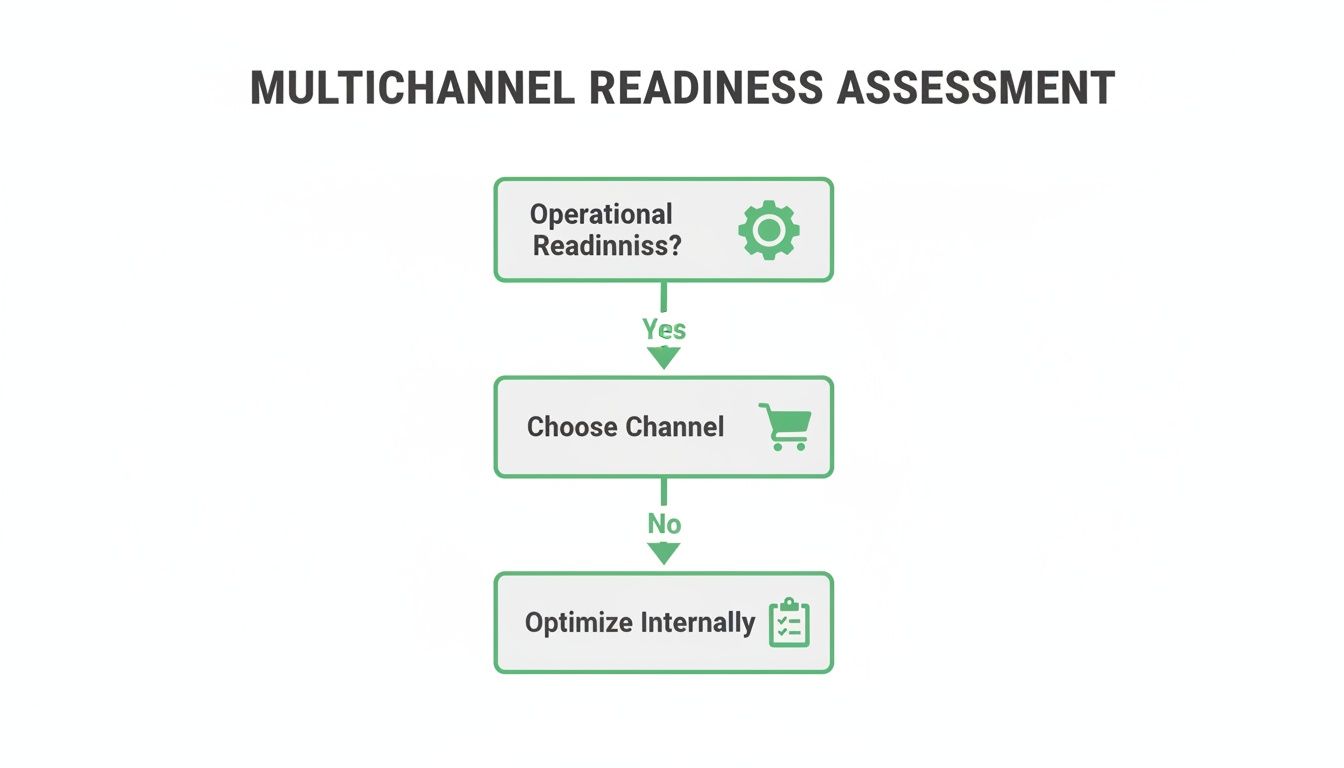
As you can see, channel selection only comes after you’ve got your house in order.
Strategic Channel Selection and Prioritization
Okay, so your operations are solid. Now for the fun part: choosing where to expand. The biggest mistake brands make here is chasing trends or jumping on a platform just because a competitor is there. Your strategy has to be smarter than that.
Go where your customers already are.
Practical Example: A brand selling high-end, technical camera gear will find its people on Amazon, where shoppers search with intense purchase intent, comparing specs and reading reviews. On the other hand, a brand with quirky, visually stunning home decor might explode on TikTok Shop, where discovery and impulse buys are driven by pure entertainment.
Key Takeaway: Don't just follow the crowd. Dig into each potential channel. Look at the audience demographics, the level of competition, and the fee structures. What works wonders for one brand could easily be a money pit for yours.
To help you think through this, here’s a simple framework comparing some of the most popular options.
Strategic Channel Selection Framework
| Evaluation Criteria | Amazon | TikTok Shop | Your DTC Website (e.g., Shopify) |
|---|---|---|---|
| Audience Intent | High purchase intent; search-driven. | Discovery & entertainment; impulse-driven. | High brand affinity; relationship-driven. |
| Primary Traffic Driver | SEO, Amazon PPC, organic search rank. | Viral content, creator collaborations, ads. | SEO, email/SMS, social media, paid ads. |
| Competition Level | Extremely high; price and review sensitive. | Growing rapidly; content quality is key. | You own the space, but must drive all traffic. |
| Customer Data Access | Very limited; Amazon owns the customer. | Moderate; access to follower data. | Complete ownership of customer data. |
| Fee Structure | Complex (referral fees, FBA, ad spend). | Lower commission; ad spend is a factor. | Platform subscription + payment processing fees. |
| Best For… | Brands with broad appeal, strong logistics. | Visually-driven, trend-responsive products. | Building long-term brand equity & loyalty. |
Choosing the right channel is about aligning the platform's strengths with your brand's goals and product type.
The data backs this up in a big way. Brands that strategically sell on three or more marketplaces see an average 104% growth in Gross Merchandise Value (GMV). This isn't just about adding revenue; it's about building resilience by not relying on a single platform. The apparel brand Adore Me, for example, doubled its net revenue by thoughtfully expanding its multichannel presence. You can find more examples of how top brands are crushing it with marketplaces in Mirakl's latest report.
Designing a Scalable Operations and Fulfillment Workflow
So you’ve picked your channels. Fantastic. Now for the hard part.
Selling products across multiple platforms is one thing; getting them to customers quickly, accurately, and without torching your profit margins is another game entirely. This is where most brands trip up. Your success in multichannel ecommerce hinges entirely on a robust operational backbone that can handle the chaos without collapsing.
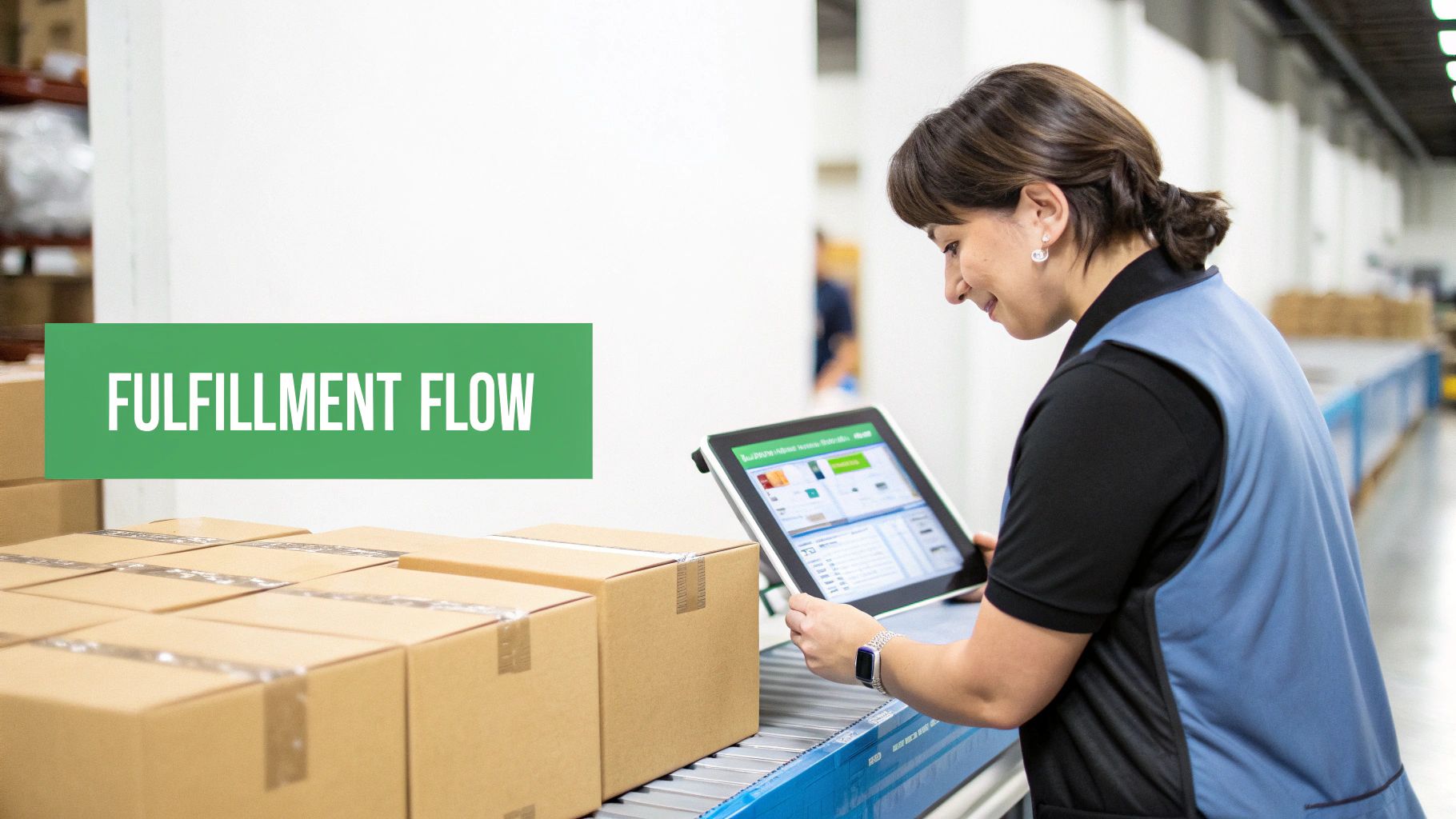
When you expand your sales footprint, you're also expanding your logistical headaches. This isn’t just about putting items in boxes. It’s about building a bulletproof system that syncs inventory in real-time, so you can avoid the dreaded oversell that tanks your reviews and puts your marketplace accounts at risk. The real goal is to design a fulfillment workflow that actually scales with your success, not against it.
Choosing Your Fulfillment Model
There's no one-size-fits-all answer here. The "best" fulfillment strategy is the one that fits your products, sales volume, and channel mix. Let's break down the three main paths you can take, each with its own pros and cons.
- Self-Fulfillment (FBM): Fulfillment by Merchant means you're doing it all yourself—picking, packing, and shipping from your own space. Example: A new Etsy seller with 5-10 orders a day for handmade jewelry can easily manage this from a home office, ensuring each package has a personal touch.
- Amazon FBA: Fulfillment by Amazon is a beast, especially for your Amazon sales. Using FBA unlocks the coveted Prime badge. Example: A brand selling a popular phone case on Amazon sends 1,000 units to FBA. Amazon handles all storage, picking, packing, and shipping for Prime orders, dramatically increasing sales velocity.
- Third-Party Logistics (3PL): Think of a 3PL partner as your outsourced warehouse and fulfillment dream team. Example: A Shopify-first apparel brand expands to Amazon and TikTok Shop. They use a 3PL to hold all inventory, so when an order comes from any channel, the 3PL picks, packs (in the brand's custom mailers), and ships it. For a deeper look, check out our guide on finding the best 3PL for Amazon sellers.
Real-World Insight: A classic rookie mistake is relying on FBA for everything. Amazon's Multi-Channel Fulfillment (MCF) service for off-Amazon orders can be slow, pricey, and worst of all, they ship in Amazon-branded boxes. Nothing kills your DTC brand vibe faster than a Prime box showing up.
Building a Hybrid Fulfillment Workflow
For most brands on the rise, the smartest play isn't picking one model—it's creating a hybrid system that leverages the best of each. This approach lets you optimize for speed, cost, and brand experience on a channel-by-channel basis.
Here's a step-by-step example of a hybrid workflow for a brand selling coffee beans:
- Inventory Split: The brand sends 30% of their best-selling "Morning Brew" blend to Amazon FBA warehouses. The remaining 70% of that blend, plus all other specialty blends, are sent to their 3PL partner.
- Order Routing (Amazon): A customer buys "Morning Brew" on Amazon. The order is automatically fulfilled by FBA to ensure 2-day Prime delivery.
- Order Routing (DTC/TikTok): A customer buys a "Tasting Flight" bundle on their Shopify site. The order is routed to the 3PL, who packs it in a custom-branded box with a thank you note and ships it via UPS Ground.
- Real-Time Sync: An inventory management software (like Linnworks or Sellercloud) acts as the central brain. When the FBA sale happens, it instantly deducts the unit from the master inventory count, preventing an oversell on Shopify or TikTok.
To truly nail your post-purchase experience, exploring different ecommerce order fulfillment services is crucial to finding the perfect match. A hybrid approach gives you the best of both worlds: Prime speed where it counts and branded control everywhere else.
Mastering the Art of Returns Management
Returns are just a cost of doing business in ecommerce. But how you handle them can either burn your margins to the ground or build surprising customer loyalty. A frustrating returns process is a known conversion killer—after all, nearly 67% of shoppers scope out the return policy before they even think about clicking "buy."
Here's a practical workflow for a "concierge returns" process:
- Initiate Return: A customer visits a branded returns portal on your site (powered by a tool like Loop Returns). They enter their order number and select the item to return.
- Automated Offer: Before confirming the refund, the portal automatically presents alternatives. Example: "Return for a full refund of $49.99, OR exchange for a new size for free, OR get $55.00 in store credit to use on anything you want."
- Instant Label: If the customer chooses a refund, a pre-paid shipping label is instantly generated and emailed to them. No waiting, no friction.
- Smart Restocking: The return arrives at your 3PL. A warehouse worker scans the item. If it's in perfect condition, it's immediately scanned back into sellable inventory, and the software syncs this update across all sales channels. The refund is then processed automatically.
This customer-first approach transforms a negative moment into a positive brand interaction. It protects your bottom line, encourages repeat business, and is an absolutely critical piece of any scalable multichannel ecommerce management strategy.
Tailoring Your Listings for Each Platform's Algorithm
Copying and pasting your product listings across every channel is one of the fastest ways I've seen brands kill their momentum. A listing that absolutely crushes it on Amazon will almost certainly fall flat on TikTok Shop, and vice versa. It's a classic rookie mistake.
Each platform has its own algorithm, a unique audience, and unspoken rules of engagement. True multichannel ecommerce management isn't about being everywhere; it's about becoming fluent in the native language of each channel you're on.
Practical Example: A shopper on Amazon searches "waterproof hiking boots for women." They have high intent. A user on TikTok is scrolling through videos and sees a creator wearing stylish boots on a rainy day. They didn't intend to shop, but they are intrigued. Your marketing must respect this difference.
This isn't about inventing new brand identities. It's simply about adapting your delivery to fit the room, making sure your core value proposition shines through in a way that feels natural, not forced.

Optimizing for High-Intent Search on Amazon
Think of Amazon’s A9 algorithm as a ruthless product search engine. Its one and only job is to find the listing most likely to result in a sale. To win here, your content needs to be packed with relevant keywords and laser-focused on clearly communicating features and benefits.
Here’s a practical step-by-step workflow for optimizing an Amazon listing:
- Keyword Research: Use a tool like Helium 10 to find the top 5-10 keywords for your product. For a yoga mat, this might be "yoga mat," "thick yoga mat," "non slip yoga mat," etc.
- Title Construction: Build your title using a proven formula:
Brand + Main Keyword + Top 2-3 Features/Benefits + Size/Color. Example: "ZenFlow Extra Thick Yoga Mat – Non-Slip TPE for Hot Yoga, 6mm with Carrying Strap – Black". - Bullet Point Writing: Dedicate each of the five bullet points to a key benefit. Start with a capitalized, benefit-focused header. Example: "NEVER SLIP AGAIN: Our proprietary TPE material provides unparalleled grip, even in sweaty hot yoga sessions, so you can hold your poses with confidence."
- A+ Content Creation: Design A+ modules that overcome common customer objections. If reviews mention a chemical smell in competing mats, create a graphic that highlights your "Odor-Free & Non-Toxic Materials."
One of the biggest mistakes I see is keyword stuffing. The A9 algorithm is smarter than that; it understands context and synonyms. Your number one goal should be creating a clear, compelling, and readable listing that converts shoppers into buyers. For a deeper dive, check out our complete guide to optimize Amazon product listings.
Crafting Content for Discovery and Impulse on Social Commerce
On platforms like TikTok Shop, you're playing a completely different game. You aren’t trying to rank for a search term—you're fighting to stop the scroll. The algorithm here is a discovery engine, built to feed users an endless stream of content it thinks they'll find engaging.
Here's a simple workflow for creating a TikTok Shop video:
- The Hook (First 3 seconds): Start with a problem or a shocking visual. Example for a yoga mat: A quick shot of someone slipping and falling on a cheap, flimsy mat, with text overlay saying "I was so tired of THIS…"
- The Solution (Seconds 4-10): Introduce your product as the hero. Show the mat being unrolled. Zoom in on the texture. Show it staying perfectly flat.
- The Demonstration (Seconds 11-20): Show the product in use, highlighting its key benefit. Example: A time-lapse of someone going through a complex yoga flow without the mat bunching or slipping once.
- The Call to Action (Final 2-3 seconds): End with a clear, direct CTA. Point to the orange shopping cart link on the screen and say, "If you want a mat that actually sticks, click the link right here to get yours."
At the end of the day, your success hinges on a simple distinction: an Amazon listing is the destination, while a TikTok Shop video is the vehicle. On Amazon, you’re convincing a shopper who is already in the store. On TikTok, you’re trying to convince someone to pull their car over and come inside in the first place.
Integrating Your Marketing for Cross-Channel Impact
Your sales channels shouldn't exist on their own little islands. The real power move in multichannel ecommerce is getting them to work together. When a win on one platform directly fuels growth on another, you create a powerful, self-sustaining engine that leaves siloed competitors in the dust.
This is about building a truly integrated marketing strategy, not just running a few separate campaigns. A killer Amazon PPC campaign isn't just an Amazon win; it’s a goldmine of conversion data. A viral TikTok video isn’t just a social media trophy; it's a firehose of traffic you can point wherever you want. The magic happens when you start connecting these dots.
Mastering Amazon PPC for Profit and Rank
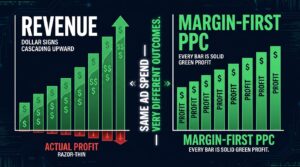
Amazon PPC is a delicate balancing act. The goal isn't just to make sales—it's to make profitable sales that also boost your product's organic search rank. Too many sellers get obsessed with chasing a super-low Advertising Cost of Sale (ACoS), starving their campaigns and killing all their momentum before it even starts.
Here is a practical workflow for launching a new product with PPC:
- Launch Defensive Campaign: Create a Product Targeting campaign that bids only on your own ASIN. This prevents competitors from showing up on your listing page. Set a modest daily budget of $10-$15.
- Launch Discovery Campaign: Create an "Auto" campaign with a moderate daily budget. Let Amazon's algorithm run for 7-14 days to find which search terms customers are actually using to find and buy your product.
- Analyze Search Term Report: After two weeks, download the Search Term Report from your Auto campaign. Sort it by "Orders" to find the exact customer search terms that generated sales.
- Harvest and Scale: Take your top 3-5 converting search terms and move them into a new "Manual – Exact Match" campaign. Bid more aggressively on these proven keywords. This focuses your budget on what works, driving profitable sales and boosting your organic rank for those terms.
This creates a beautiful feedback loop. Your ads drive sales, which improves your organic rank. Better rank leads to more organic sales, giving you more profit to reinvest into even more strategic ad spend.
Tapping into TikTok Shop's Creator-Led Ecosystem
Marketing on TikTok Shop is a completely different game. You're not bidding on keywords; you're partnering with people. The entire platform runs on authenticity, and the most powerful marketing comes from creators who genuinely connect with what you're selling.
Finding the right partners is everything. Forget just looking for a massive follower count. You need creators whose audience is a mirror image of your ideal customer and whose personal brand feels like a natural fit for your own.
Here’s a practical workflow that works:
- Scout the Affiliate Marketplace: Dive into TikTok's own marketplace. Use the filters to zero in on creators by niche (e.g., "skincare"), audience size (e.g., 10k-50k followers), and performance (e.g., high GMV).
- Vet Potential Partners: Click into the profiles of 10-15 potential creators. Watch their last 5 videos. Do they get real engagement (comments, shares)? Does their audience seem to trust their recommendations? Example: If you sell a vegan protein powder, a creator whose audience is asking for plant-based recipes is a perfect fit.
- Run a Test Campaign: Reach out to 3-5 of your top prospects. Offer them a free product and a commission rate (e.g., 15%). Give them a few key talking points but encourage creative freedom.
- Track and Scale: Monitor the results in your TikTok Shop dashboard. If one creator's video drives significant sales, reach out to them for a paid collaboration or a long-term partnership. Double down on what works.
Key Insight: The best TikTok Shop content almost never looks like an ad. It feels like a real person sharing a genuine discovery. A creator showing how your product actually solved a problem for them is infinitely more compelling than a slick, brand-produced video.
Creating a Self-Sustaining Marketing Loop
Now, let's tie it all together. This is how you stop thinking in terms of separate tactics and start building a cohesive growth machine. The objective is to make each channel's success feed the others, creating a virtuous cycle of traffic, data, and sales.
Let's say you're launching a new kitchen gadget. Here’s how the loop could play out:
- Step 1: Ignite with TikTok: You partner with a food creator who posts an incredible video showing off your gadget. It takes off, hitting 500,000 views and driving a flood of initial sales on TikTok Shop.
- Step 2: Fuel Amazon Rank: You take the creator's winning video and run it as an ad on Facebook and Instagram. But instead of linking to your website, you link directly to your Amazon listing using an Amazon Attribution link. This surge of high-intent external traffic is a massive positive signal to the A9 algorithm, boosting your organic rank.
- Step 3: Build DTC Lookalikes: As your Amazon sales climb, you use tools to analyze your Amazon customer data (even if anonymized). You discover your core Amazon buyer is a female, age 35-50, interested in healthy cooking. You then use this profile to build a highly targeted Lookalike Audience on Facebook to drive traffic to your own Shopify store for higher-margin sales.
This cross-pollination of traffic and data is the heart of advanced multichannel ecommerce management. You use the discovery power of social commerce to supercharge the search-driven engine of Amazon, then use Amazon's data to efficiently find new customers for your own site.
Building Your Multichannel Tech Stack (with a Little Help from AI)
As your brand grows, manual processes go from being a minor headache to the single biggest anchor holding you back. That trusty spreadsheet that worked for 50 Shopify orders a month? It will absolutely crumble under the weight of 500 orders spread across Amazon, TikTok Shop, and your own website.
To really scale, you have to move away from manual grunt work and build an automated, interconnected tech stack. Think of it as the central nervous system for your business—one that handles all the repetitive tasks so you can focus on strategy, product, and growth. The goal is simple: work less, sell more.
Nail the Basics First: Your Tech Stack’s Foundation
Before you get distracted by the shiny new AI tools, you need to lock down the two foundational pillars of your tech stack. Without these, no amount of fancy software can save you from operational chaos.
- Centralized Inventory Software: This is your single source of truth for stock levels. Practical Example: You have 100 units of a T-shirt. You sell one on Amazon. Your inventory software (like Linnworks) instantly tells Shopify and TikTok Shop you now only have 99 units available. This prevents overselling.
- Order Management System (OMS): Think of an OMS as the air traffic controller for your business. Practical Example: An order comes in from TikTok Shop. Your OMS sees the customer is in California and automatically routes the order to your 3PL partner in Nevada for cheaper, faster shipping, then sends tracking info back to TikTok.
These two systems are the non-negotiable backbone of any serious multichannel ecommerce management strategy. Get them right, and everything else becomes easier.
Where AI Actually Makes a Difference (Beyond the Hype)
Artificial intelligence isn't just a buzzword; it’s a practical toolkit for automating complex tasks and making smarter, faster decisions. It’s about offloading the mind-numbing, repetitive work so you can apply your human expertise where it truly matters.
Here are practical examples of AI in action:
- Smarter Customer Service: A customer asks "Where is my order?" in your website's chat. An AI chatbot (like Gorgias) connects to your OMS, finds the tracking number, and provides a direct link to the shipping status—all without human intervention.
- Channel-Specific Listing Copy: You paste your Shopify product description into an AI tool (like Jasper). You then prompt it: "Rewrite this for an Amazon listing, focusing on benefits and including the keywords 'durable,' 'lightweight,' and 'travel-friendly'." It generates five optimized bullet points in seconds. We've written a whole guide on how to implement AI in ecommerce brands if you want to go deeper.
- Intelligent PPC Analysis: An AI ad tool (like Perpetua) analyzes your Amazon PPC campaigns and notices you're spending $50 to get one sale on the keyword "red sneakers," but only $5 for the keyword "running shoes for men." It automatically lowers your bid on the unprofitable term and increases it on the profitable one.
- Predictive Inventory Forecasting: By analyzing past sales, an AI tool might predict a 300% spike in demand for your sunscreen product in May. This prompts you to place a larger-than-usual purchase order in March, preventing a costly stockout during your peak season.
Real-World Scenario: Imagine launching a new line of activewear. In the past, this meant weeks of expensive photoshoots. Today, you can generate AI models for clothing to create endless visual variations for different channels, dramatically cutting content costs and letting you test visuals on the fly.
Essential Multichannel Tech Stack Components
To tie all of this together, you need the right software. Here’s a look at the core categories and some popular tools that can automate and scale your operations.
| Tool Category | Core Function | Example Tools & AI Integration |
|---|---|---|
| Inventory & Order Management | Acts as the central hub for stock levels, order routing, and fulfillment across all sales channels. | Linnworks, Sellercloud, Sello. AI helps with predictive forecasting and intelligent order routing. |
| PIM (Product Information Management) | Centralizes all product data (descriptions, images, specs) and syndicates it to different channels. | Pimcore, Akeneo. AI can generate channel-specific copy and meta descriptions. |
| Customer Service Helpdesk | Consolidates customer inquiries from all channels into a single inbox for efficient support. | Gorgias, Zendesk. AI-powered chatbots handle common questions and automate ticket routing. |
| Analytics & Reporting | Aggregates data from all channels to provide a unified view of business performance. | Triple Whale, Glew.io. AI features can identify trends and surface growth opportunities. |
| PPC & Advertising Automation | Manages and optimizes paid ad campaigns on platforms like Amazon, Google, and Meta. | Perpetua, Sellozo. AI automates bidding, keyword harvesting, and budget allocation. |
This table isn't exhaustive, but it covers the foundational pieces you'll need. The right combination of these tools will create a powerful, automated system that runs your business with you, not against you.
This level of automation is becoming critical. Global online sales are projected to hit $7.89 trillion by 2028, and with multichannel commerce growing at a blistering 17.7% CAGR, an AI-powered tech stack is no longer a luxury. It's how you stay competitive and capture your piece of the pie without getting buried in operational quicksand.
Answering Your Top Questions About Multichannel Ecommerce Management
Moving into multichannel sales is a huge step, and it naturally brings up a lot of questions. It's a major strategic shift that adds new layers of complexity to your operation. Let's walk through some of the most common questions we hear from brands starting this journey, with clear, actionable answers to help you move forward.
What Are the First Steps to Take When Expanding from a Single Channel?
The temptation is always to jump right in and start researching the hottest new platforms. Don't. The real first step in successful multichannel ecommerce management isn't looking outward; it's looking inward with a serious internal audit.
Here is a simple 3-step workflow to follow:
- Inventory Accuracy Audit: Manually count your top 10 SKUs. Does the physical count match what your system says? If not, you must fix your inventory tracking process before adding a new channel. An error of just 2-3 units can lead to overselling and account suspension.
- Profitability Deep Dive: Pull up a specific product. Calculate your exact net profit after product cost, shipping, payment processing fees, and marketing spend. Example: A $50 t-shirt might have a $10 product cost, $5 shipping, $2 in fees, and $8 in ad cost, leaving you with $25 profit. You need this number to evaluate if a new channel's fees (like Amazon's 15% referral fee) will still be profitable.
- Team Capacity Check: Map out the daily tasks required for your current channel (e.g., answering 15 customer emails, packing 30 orders, creating 2 social posts). Now, realistically double the customer service and marketing tasks. Does your current team have the hours in the day to handle that, or do you need to hire or automate?
Only after this internal checkup are you ready to explore new channels.
How Do I Keep My Branding Consistent Across Different Platforms?
Brand consistency across channels isn't about just copying and pasting your content. It’s about making sure your brand’s core personality, look, and feel are instantly recognizable, even when you adjust the format and tone to fit the platform. One of the biggest mistakes we see is brands using the same robotic, feature-heavy copy from an Amazon listing in a TikTok video description—it just feels weird and out of place.
Practical Example: A playful, witty snack brand might use humorous, meme-style content on TikTok. On their Amazon A+ Content, that same wit comes through in clever headlines and graphics, but the core bullet points are direct and benefit-focused to help a customer make a quick purchase decision. The personality is consistent, but the delivery is native to the platform.
The key is a rock-solid brand style guide. This document is your North Star, clearly defining your:
- Logo usage and color palette: The non-negotiable visual anchors of your brand.
- Typography: The specific fonts that represent your look.
- Tone of voice: Are you witty and informal? Authoritative and expert? Minimalist and chic?
Expert Tip: Set up a Digital Asset Management (DAM) system. Even a well-organized Google Drive or Dropbox folder can do the trick. Create subfolders for "Logos," "Product Photography," and "Lifestyle Images." This ensures your social media manager and your Amazon listing specialist are pulling from the same approved library, preventing inconsistencies.
What Are the Most Common Mistakes to Avoid?
The most common—and most expensive—mistake is thinking that a strategy that crushes it on one platform will automatically work on another. That "copy-paste" approach completely ignores the unique algorithms, user behaviors, and content expectations of each channel. You absolutely have to tailor your approach.
A close second is failing to invest in centralized inventory management from day one. Practical Example: You have 5 units of a product left. You sell 3 on your website and 3 on Amazon in the same hour. Because your inventory didn't sync in real-time, you've now oversold by one unit. You must cancel the Amazon order, which damages your account health and leads to a negative review.
Another classic oversight is underestimating the customer service load. Shoppers expect fast, helpful support inside the platform where they bought from you. Answering a direct message on Amazon is a totally different beast than responding to a TikTok comment or engaging in a live chat on your own site. Slow or generic responses on any channel create a poor experience and burn trust.
Finally, a critical error is failing to track profitability on a per-channel basis. It's so easy to get caught up in rising top-line revenue, but you might not realize that one of your channels is actually a money pit because of high commission fees, ad spend, or return rates. You have to put the analytics in place to measure the true profit contribution of each channel on its own.
When Should I Consider Outsourcing My Multichannel Management?
The right time to think about outsourcing is the moment complexity starts pulling you away from your most important job: growing the business. If you find yourself spending more time putting out operational fires—like FBA prep, returns processing, or tweaking PPC bids—than you do on product development and big-picture brand strategy, that’s your sign.
Here are a few specific triggers that tell you it's time to bring in an expert partner:
- You're Spending Hours on Repetitive Tasks: You find yourself manually downloading Amazon sales reports every day to update your master inventory spreadsheet. An agency would automate this in minutes.
- Your Ad Performance is Stagnant: Your Amazon PPC ACoS has been stuck at 40% for months, and you don't know which levers to pull to improve it. An expert lives and breathes this and can diagnose the problem quickly.
- You Can't Keep Up with New Features: You hear about a new tool like TikTok Shop video ads but don't have the bandwidth to learn the platform, create the content, and manage the campaigns.
Bringing on a specialized consultancy isn't just about handing off tasks. It’s about getting instant access to a team with proven strategies, established workflows, and deep industry knowledge that can help you scale faster and more profitably than you ever could on your own.
Ready to scale your brand across multiple channels without the operational headaches? The team at ZonFlip provides end-to-end management for Amazon and TikTok Shop, guided by a "First Profit, Then Progress" philosophy that protects your margins while accelerating growth. Learn how we can help you sell more and work less.