



Frustration-Free Packaging (FFP) is Amazon's answer to a universal customer headache: packaging that’s a nightmare to open. It’s a design philosophy and a full-blown certification program aimed at creating packaging that is 100% recyclable, a breeze to open, and tough enough to ship in its own box.
No more impossible-to-open plastic clamshells. No more annoying wire ties. Just a better unboxing experience and a whole lot less waste.
Decoding The Frustration Free Packaging Concept
Think about the last time you ordered something online. Did you need scissors, a box cutter, and a healthy dose of patience to free your product from its plastic prison? That's what the industry calls "wrap rage," and it's the exact problem FFP was created to solve.
FFP is all about flipping that script. It’s a packaging mindset, pioneered by Amazon, that puts your customer's experience first. Instead of a struggle, they get a simple, satisfying unboxing.
To really get it, you have to understand the fundamental differences between packaging and shipping supplies. Traditional retail packaging is designed for a physical shelf—it needs to be flashy, glossy, and theft-proof. FFP, on the other hand, is built from the ground up for e-commerce.
The Core Pillars of FFP
This modern approach to packaging stands on three simple but powerful pillars. To get certified, your packaging must be:
- Easy to Open: The customer should be able to get to the product in under 120 seconds, usually without any tools. A practical example is a box with a perforated tear-strip that opens with a single pull, instead of one sealed with layers of packing tape requiring a knife.
- 100% Recyclable: Every single component has to be curbside recyclable. This means using corrugated cardboard and paper-based inserts instead of Styrofoam blocks, plastic air pillows, or bubble wrap.
- Protective (Ships in Own Container): The box itself needs to be sturdy enough to survive the journey from the warehouse to the customer's doorstep without needing an extra Amazon shipping box. This is a huge deal for reducing waste.
So, instead of a toy car twisted onto a cardboard backing with a dozen wire ties and sealed in a plastic blister pack, the FFP version arrives in a simple, branded cardboard box that a kid can actually open.
Let's break down the key differences in a quick table.
Frustration Free Packaging At A Glance
This table gives a clear, side-by-side look at how FFP stacks up against the old-school retail approach.
| Feature | Frustration-Free Packaging (FFP) | Traditional Retail Packaging |
|---|---|---|
| Primary Goal | Streamline shipping & enhance unboxing | Attract in-store attention & prevent theft |
| Opening Experience | Easy, tool-free, under 120 seconds | Often difficult, requires tools (wrap rage) |
| Materials | 100% curbside recyclable (cardboard, paper) | Mixed materials (plastic, wire ties, glue) |
| Shipping Method | Ships in its own container (SIOC) | Requires an outer shipping box (overbox) |
| Waste Reduction | High; minimizes materials and excess space | Low; creates significant excess waste |
| Cost Focus | Reduces shipping & material costs | Prioritizes visual appeal over efficiency |
As you can see, the two are designed for completely different worlds. FFP is engineered for efficiency and customer happiness in an e-commerce environment.
FFP isn't just about making customers happier; it's a strategic response to the demands of e-commerce logistics. It streamlines the fulfillment process, reduces shipping costs by minimizing dimensional weight, and lowers the carbon footprint of each sale.
Amazon kicked off this whole initiative back in 2008 with just 19 products. Fast forward to today, and over 750,000 products are FFP-certified. That massive shift shows you just how powerful this customer-first, efficiency-driven approach is. It’s a smarter, more sustainable way to get your products into your customers' hands.
Exploring The Three Tiers Of Amazon Packaging
Amazon's packaging program isn't a one-size-fits-all mandate. Think of it more like a flexible framework with three distinct tiers, each designed to help different products and sellers get on board. This tiered approach creates a practical path for almost any item you sell to reduce waste and give customers a better experience.
Understanding these levels is the first step in figuring out the right strategy for your brand. Each tier has its own requirements, benefits, and things to consider for your operations. Let's break them down, starting with the gold standard.
Tier 1: Frustration-Free Packaging (FFP)
Frustration-Free Packaging (FFP) is the top of the mountain—the absolute gold standard. It’s the ultimate goal of the program, rolling all the best practices into one perfect, streamlined package. To get FFP certified, your product has to meet the toughest criteria to guarantee the best possible unboxing experience.
When a product is certified for FFP, it’s basically ready for its entire e-commerce journey the moment it leaves the factory. Picture a kitchen blender. Traditionally, it might be in a glossy box with Styrofoam, all packed inside another shipping box. The FFP version? It shows up in a single, right-sized, sturdy cardboard box with paper-based inserts. The customer just pulls a tear-strip, opens it up, and lifts out the blender. No extra layers, no plastic peanuts, no hassle.
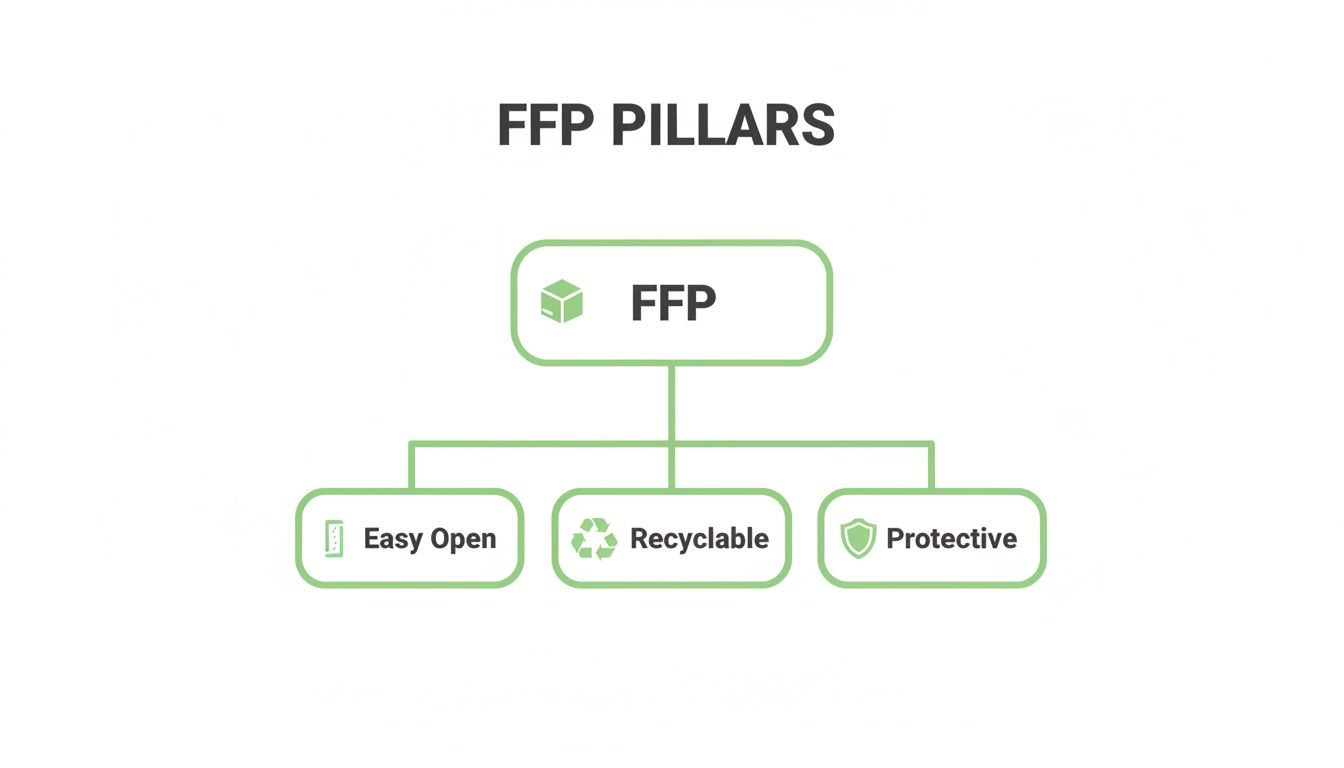
This diagram nails the three pillars of FFP. It’s a balancing act between protecting the product, making it easy to open, and ensuring everything can be tossed right into the recycling bin.
Tier 2: Ships in Own Container (SIOC)
The next step down is Ships in Own Container (SIOC). Just like the name says, these products can ship safely in their own branded box without Amazon needing to slap it inside one of their brown overboxes. This tier gives you many of the same cost-saving and waste-reducing perks as FFP.
So, what's the catch? SIOC is a bit more forgiving. The packaging still has to survive tough transit tests (like being dropped and shaken), but it might not check every single box for being "easy to open" or "100% recyclable." For example, a SIOC product might ship in a box that still needs a knife to cut the tape, or maybe it has a small plastic handle.
A perfect real-world example of SIOC is a pair of durable work boots. The shoebox itself is already tough enough. By just adding a shipping label directly to it, the shoebox can handle the journey alone, completely getting rid of the need for an extra box.
This makes SIOC a fantastic and achievable goal for a lot of brands. You can slash your packaging waste and shipping costs without having to completely redesign everything, as long as your main container is solid enough to make the trip.
Tier 3: Prep-Free Packaging (PFP)
Last but not least, we have Prep-Free Packaging (PFP). This tier is for products that aren't quite ready to ship on their own and still need an Amazon overbox for protection. The key here is that they are packaged so that they require zero additional prep work from the staff at Amazon's fulfillment centers.
This means your product shows up at the warehouse ready to go. No one at Amazon needs to put it in a poly bag, wrap it in bubble wrap, or add extra tape before it goes into the final shipping box. It makes the whole fulfillment process faster and cuts down on the chance of handling mistakes.
- PFP Requirement: No extra prep needed by Amazon staff.
- Shipping Method: Requires an Amazon overbox.
- Key Benefit: Speeds up fulfillment and helps you avoid non-compliance fees for items that would otherwise need special handling.
Think about a set of glass food containers. The retail box they come in might not be tough enough for shipping, but it holds the containers securely. As long as Amazon can just place that box directly into one of theirs without adding bubble wrap, it qualifies for PFP. Simple, fast, and efficient.
The Strategic Benefits For Brands And Customers
Moving to Frustration-Free Packaging (FFP) isn't just a small operational tweak. It’s a genuine business strategy that sends positive ripples through your entire operation. The upside goes way beyond your warehouse, directly touching customer perception, brand loyalty, and your bottom line. By simply rethinking the box, brands can unlock some serious advantages.
This is about more than just playing by Amazon's rules. It’s about realizing the customer journey doesn’t stop at the “buy” button—it truly ends when they have a fantastic unboxing experience.

A Better Customer Experience
The first and most obvious win from FFP is a huge leap in the customer experience. We’ve all been there: fighting with wire ties, impossible-to-open plastic clamshells, and way too much tape. That initial struggle, sometimes called "wrap rage," can instantly tarnish an otherwise great purchase.
FFP completely gets rid of that headache. When a customer can open their package in just a few seconds with a simple tear-strip, it’s a moment of pure relief and delight. That seamless experience has a direct impact on your business.
- Higher Customer Satisfaction: An easy unboxing makes customers feel like you respect their time. It’s a small thing that makes a big difference.
- Improved Product Reviews: Happy customers who have a smooth, enjoyable first interaction with your product are far more likely to jump online and leave a glowing review.
- Stronger Brand Loyalty: That positive unboxing moment becomes part of your brand’s story, building trust and encouraging people to buy from you again.
Ultimately, making the switch to FFP is a key way to improve ecommerce customer experience and ensure that final touchpoint with your customer is a positive one.
A Commitment To Sustainability
Let's be real: today’s shoppers care about the planet. They’re actively looking for brands whose values match their own, and packaging is one of the most visible signs of a company’s environmental commitment. FFP is built on using minimal, 100% recyclable materials, which speaks directly to this growing market.
When you ditch the extra plastic and oversized boxes, you’re not just cutting down on waste—you're sending a powerful message about your brand. This eco-friendly stance boosts your brand image, helping you attract and keep customers who put the planet first.
It's not just a hunch; the numbers back it up. An Amazon survey found that a whopping 87% of customers have a better experience thanks to easy-to-open packaging that ensures their items arrive safely. Just look at Amazon's redesign for a Star Wars toy: they cut the packaging from 24 separate components (think outer boxes, wire ties, and plastic bits) down to just 4. That’s an 83% reduction in material without sacrificing safety. The environmental impact is massive, with over 1.5 million tons of packaging material eliminated since 2015.
The Operational And Financial Wins
Beyond making customers happy, FFP delivers some serious operational and financial perks that hit your bottom line directly. This is where the strategy really starts to pay for itself. The gains in efficiency are clear and easy to measure, making it a no-brainer for any brand looking to sharpen its operations.
These wins come from a few key places:
- Reduced Material Costs: By its very nature, FFP uses less stuff. Getting rid of all the inserts, fillers, and giant boxes means you spend less on packaging for every single item you ship.
- Lower Shipping Fees: Carriers charge based on dimensional weight (DIM). FFP’s compact, right-sized boxes take up less space, which translates into lower FBA fees and shipping costs.
- Decreased Damage Rates: FFP isn’t just minimal; it’s engineered and tested to handle the rough and tumble of shipping. This means fewer products get damaged on their way to the customer.
- Fewer Customer Returns: When products show up in one piece and are easy to open, customers have far fewer reasons to send them back. This protects your revenue and cuts down on the costs of reverse logistics. If you're looking to tighten up your fulfillment, check out our guide on how to sell on Amazon FBA.
At the end of the day, Frustration-Free Packaging is a true win-win-win. Your customers get a better experience, your brand builds a stellar, sustainable reputation, and your business runs a leaner, more profitable fulfillment process.
Navigating The FFP Testing And Certification Process
Getting your packaging certified as Frustration-Free might sound intimidating, but it's really just a structured, manageable process. Think of it less as a hurdle and more as a quality-control gauntlet that proves your product can handle the rough-and-tumble world of e-commerce, from warehouse vibrations to last-mile drops.
At its core, the whole system is about protecting your product, delighting your customer, and ultimately, safeguarding your bottom line. It all revolves around a standardized set of tests designed to mimic a package's real-world journey. Understanding this "boot camp" for your packaging is the first step to earning that coveted FFP badge on your product detail page.
Understanding ISTA 6-Amazon.com Testing
The gold standard for this whole process is the ISTA 6-Amazon.com test series. This isn't some arbitrary checklist Amazon dreamed up; it was developed in partnership with the International Safe Transit Association (ISTA) to create a series of physical trials that truly simulate the stresses of modern shipping.
Your packaged product will be put through its paces to see how it holds up. This isn’t about just tossing a box around; it’s a scientific method for guaranteeing durability before your products ever reach a customer.
The main challenges in the ISTA 6-Amazon.com test include:
- Vibration Tests: These replicate the constant rattling and shaking a package endures in the back of a delivery truck or on a fast-moving conveyor belt. For example, a box of glassware would be vibrated at various frequencies to ensure the glasses don't clink together and crack.
- Drop Tests: Get ready for impact. Your package will be dropped from specific heights, landing on its corners, edges, and flat sides. A package containing a laptop, for instance, might be dropped 10 times from 30 inches to simulate falls during handling.
- Compression Tests: This test simulates the immense weight of other boxes being stacked on top of yours in a warehouse or delivery truck. A box of cereal might have a 200 lb weight placed on it to confirm it won't be crushed under a stack of other groceries.
Passing these tests is definitive proof that your packaging is ready for action.
Finding A Lab And Kicking Off The Process
You can't just run these tests in your own warehouse and call it a day. To maintain total impartiality and accuracy, Amazon requires all testing to be conducted by a certified, third-party lab. This is where the Amazon Packaging Support and Supplier Network (APASS) comes into play.
APASS is a network of pre-vetted companies and labs that are experts in Amazon's specific packaging requirements. Working with an APASS partner is the most reliable and straightforward way to get started.
Here’s a practical workflow for getting certified:
- Find an APASS Lab: Use Amazon's official APASS provider list to find a certified testing facility that fits your location and budget.
- Submit Your Product: Send several samples of your fully packaged product (exactly as a customer would receive it) to the lab for evaluation.
- Testing Begins: The lab will run your package through the full ISTA 6-Amazon.com gauntlet, carefully documenting its performance during vibration, drop, and compression tests.
- Receive Your Report: Once testing is complete, the lab provides a detailed report. It will either be a clear pass or will include specific, actionable feedback on failures (e.g., "product shifted and broke internal supports during corner drop test").
- Iterate or Submit to Amazon: If the package passes, you can submit the report directly to Amazon through Vendor or Seller Central. If it fails, use the lab's feedback to improve the design and re-submit for testing.
The testing phase is absolutely critical. A failure isn't a dead end—it's incredibly valuable data. It tells you exactly where your packaging is weak, allowing you to iterate on the design. Maybe you need to add better internal supports or switch to a stronger grade of cardboard before you retest.
This structured validation ensures that when your product finally ships, it’s not just in a good-looking box, but in one that has been battle-tested and proven to work. For brands juggling complex logistics, getting expert help can make all the difference. To explore this further, learn more about 3PL storage and prep services that can support your packaging transition.
Your Step-By-Step FFP Implementation Checklist
Making the switch to Frustration-Free Packaging isn't some massive, complicated overhaul. Think of it as a smart, strategic move that sharpens your operations and makes customers happier. It’s a logical process, and this checklist breaks it all down into simple, manageable phases.
Follow these steps, and you’ll methodically build a better packaging solution that cuts costs, boosts your brand's green credentials, and creates that "wow" moment when a customer opens your box.
Let's walk through exactly how to get it done.
Here's a high-level look at the journey from your current packaging to a fully certified FFP solution. Each phase has a clear purpose, guiding you toward a more efficient and customer-friendly operation.
FFP Implementation Checklist For Brands
| Phase | Key Actions | Primary Goal |
|---|---|---|
| 1. Product & Packaging Audit | Analyze current packaging, identify high-damage products, and measure dimensional weight inefficiencies. | Establish a clear baseline and prioritize which products to transition first. |
| 2. Design & Prototyping | Collaborate with designers, source 100% curbside recyclable materials, and create initial physical prototypes. | Develop a protective, compact, and sustainable package design ready for testing. |
| 3. APASS Lab Testing | Partner with a certified APASS lab to perform the mandatory ISTA 6-Amazon.com tests on your prototypes. | Get official, impartial validation that your packaging meets Amazon's durability standards. |
| 4. Submission & Certification | Submit the certified test report from the lab to Amazon through Seller or Vendor Central. | Secure your official FFP, SIOC, or PFP certification and unlock the program's benefits. |
Now, let's dig into the details of what each phase really involves.
Phase 1: Product And Packaging Audit
Before you can build a better box, you have to know what you’re working with. This first step is all about doing a deep dive into your current product lineup and its packaging. This audit is absolutely critical—it’s where you’ll spot your biggest opportunities and your most painful weaknesses.
Your main job here is to gather data. Get specific and ask the tough questions:
- Vulnerability: Which of our products get damaged the most during shipping? For example, check your return reports for "damaged in transit" to identify that your ceramic mugs have a 15% damage rate, making them a top priority.
- Dimensions: Where are we wasting money on dimensional weight? Pull a shipping report and find a product where the box is 50% empty space—a clear sign you're overpaying.
- Materials: How much plastic, foam, and unnecessary filler are we paying for and shipping out?
This review gives you a solid baseline to work from, making it obvious which products you should tackle first. It also gives your design partners the exact data they need to start creating effective solutions. For a hand with this, exploring professional Amazon FBA prep services can help you nail down these operational details.
Phase 2: Design, Prototyping, And Sourcing
Once your audit is done, it's time for the fun part: the redesign. Find packaging designers or suppliers who get e-commerce and, more importantly, know Amazon’s rules inside and out. The mission is to create prototypes that are tough, compact, and eco-friendly.
Make it a priority to source 100% curbside recyclable materials. Think corrugated cardboard and paper-based inserts. This isn't just a suggestion; it's a core requirement of the FFP program. In this stage, you should get physical prototypes made that you can kick around and test yourself. For instance, if you're redesigning the packaging for those ceramic mugs, create a prototype with molded pulp inserts, seal it, and drop it from your desk a few times to see how it holds up.
Phase 3: Partnering With An APASS Lab For Testing
Okay, you've got a prototype that looks promising. Now it's time to see if it can take a punch. You have to work with a lab from the Amazon Packaging Support and Supplier (APASS) network. These labs are the certified pros who know how to perform the required ISTA 6-Amazon.com tests.
Sending your packaged product to an APASS lab gives you an unbiased verdict that meets Amazon's tough-as-nails standards. They will put your package through the wringer with drop tests, vibration tests, and compression tests that mimic the entire chaotic journey to a customer's doorstep. This isn't just about checking a box for compliance; it's about making sure your product actually survives.
A failed test isn't a failure—it's incredibly valuable feedback. The lab report will show you exactly where the package broke down, like a crushed corner or a product shifting inside. This lets you go back to the drawing board with hard data to make your next design even better.
Phase 4: Final Submission And Certification
After your package finally passes the ISTA 6-Amazon.com gauntlet, the lab will issue a detailed, certified report. This report is your golden ticket. The last step is simple: submit this documentation to Amazon through Seller Central or Vendor Central.
Once Amazon gives the green light, your product officially earns its FFP, SIOC, or PFP certification. This is where you start seeing the rewards—potential FBA fee discounts, a better customer experience, and that coveted FFP badge on your product detail page.
This isn't just a box-ticking exercise; it's a powerful investment in your brand. The global frustration-free packaging market is on track to double, jumping from USD 1.5 billion in 2025 to USD 3.0 billion by 2035. Why? Because it slashes inefficiencies and makes brands look good. By following this checklist, you’re setting your brand up to ride this wave. You can discover more about the FFP market boom on futuremarketinsights.com.
Answering Your FFP Questions
Making the leap to Frustration-Free Packaging can feel like a big project, and it's natural to have questions. Most brands are curious about the costs, timelines, and which products even qualify.
Let's break down some of the most common questions we hear from sellers getting ready to make the switch.
What Are The Main Costs Of Switching To FFP?
The initial investment in FFP really boils down to three key areas. It's important to look at these not just as costs, but as investments that pay off down the road.
- Packaging Redesign: You’ll be working with packaging engineers or designers to create new, compliant prototypes that are both protective and compact. For a small product, this might cost a few hundred dollars; for complex electronics, it could be several thousand.
- Material Costs: The good news is that simpler, sustainable materials like corrugated cardboard are often cheaper per unit. The main task here might be finding and vetting new suppliers.
- ISTA-6 Testing: This one’s non-negotiable. You have to partner with a certified APASS lab for testing, which typically costs between $500 and $1,000 per product.
While these upfront costs are real, they are almost always offset by long-term savings. Think lower FBA fees, fewer products damaged in transit, and a drop in customer returns.
Can Any Product Be Certified For FFP?
Most products can get the FFP nod, but there are a few important exceptions to keep in mind. While the program is built to handle a huge range of goods, safety and regulations always come first.
Generally, products that fall under hazardous materials (Hazmat)—think items with lithium-ion batteries or flammable liquids—are a no-go. They have their own strict packaging rules that don't align with standard FFP. The same goes for certain extremely fragile or sharp items that need special handling.
The real litmus test is this: can the product be shipped safely and securely in its own box without any extra prep? If it poses a risk to warehouse staff, delivery drivers, or other packages, it's likely not a candidate. For example, a bottle of bleach cannot be FFP-certified, but a microwave oven is an ideal candidate.
How Long Does The Certification Process Take?
The timeline really depends on how prepared you are and how complex your new design is. A good ballpark estimate, from your first design concepts to getting the final green light from Amazon, is typically four to eight weeks.
This window covers the whole process: the initial audit, design and prototyping, shipping samples to an APASS lab, running the ISTA-6 tests, and submitting the final paperwork to Amazon. Keep in mind, if a test fails, you'll have to go back to the drawing board for a redesign and retest, which will extend that timeline.
Does FFP Certification Improve My Product Ranking?
Here's the straight answer: FFP certification won't directly boost your product's ranking in Amazon's A9 search algorithm. But its indirect benefits are huge and can absolutely give you a competitive edge.
Better packaging means fewer damaged products and fewer returns, which helps protect your overall account health. More importantly, a great unboxing experience often leads to better product reviews and seller feedback. Those positive signals are exactly what Amazon's algorithm loves to see, helping to lift your product's organic visibility over time.
Ready to make the switch to frustration-free packaging but not sure where to start? ZonFlip provides end-to-end Amazon account management, including optimizing your packaging and prep to boost customer satisfaction and protect your margins. Learn how we can help you grow.